Nikita Teryoshin

Verden, Lower Saxony, Show of the Best

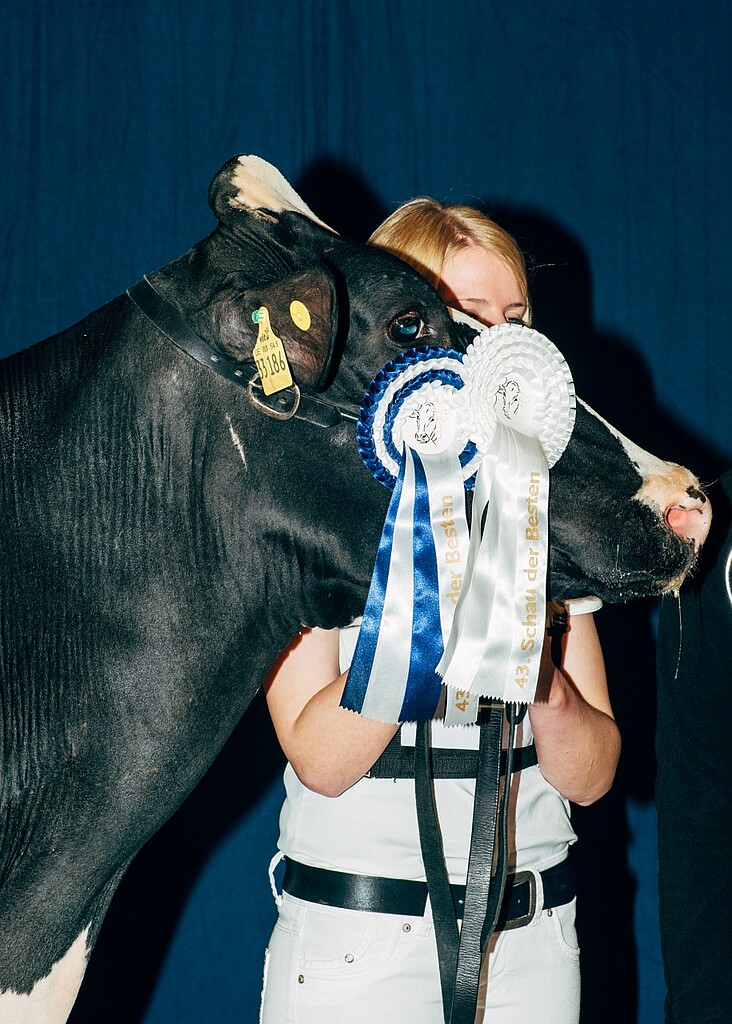
A young cattle breeder and her winning cow on stage during the award ceremony of the 43rd Show of the Best in Verden.

Dr. Markus Schmid

Scientist at the University of Hohenheim’s Department of Department of Animal Genetics and Breeding

A healthy herd with high output is the pride of every dairy farmer. And rightly so, as the herd is the basis of the dairy farm's income. 

Animal health is a key factor here, and not just financially. A healthy herd costs less money, but above all less time, which can benefit family life. 

Breeding is an important component in maintaining good performance and improving health. Accordingly, every breeding farm should be proud of its successes in this respect. The breeding associations in Germany offer both an infrastructure for breeding work and a showcase for success.

Raoul von Schmettow

Director of dairy farming at the Meiereihof research station, University of Hohenheim

Such cows are cared for on the farms and usually have a very close relationship with their owners. 

Back to the top

Sara Dusel

Research associate and doctoral candidate in the “Agricultural and Food Policy” department at the University of Hohenheim

I find this photo particularly exciting in connection with the title “winner’s interview" and the subtitle. The cow is invited to the TV studio as the winner and is thus portrayed as an important player. 

We are thinking along similar lines in our research. We look at the costs and benefits of policy measures to improve animal welfare, e.g. regulations on calf husbandry. With it, we investigate how costs and benefits can be calculated in euros from the animals’ point of view – and not just from the perspective of agriculture, as is currently the case. 

For example, how would the winning cow assess the costs and benefits of her milk yield? If the winning cow had money, how much would she pay to go out to pasture? We try to answer such questions on the basis of animal science research and a number of additional assumptions, making animals economic actors in their own right that can be taken into account in cost-benefit analyses.


Back to the top

Prof. Dr. Regina Birner

Director, Department of “Social and Institutional Change in Agricultural Development,” University of Hohenheim and trained farmer

The picture brings back memories of my agricultural training in the 1980s on a dairy farm in Upper Bavaria. 

There I was able to experience how great and contagious the enthusiasm of young farmers for breeding their dairy cows can be. The young breeders’ club, which still exists today, played an important role in this. 

I can still remember well how the young breeders proudly presented their breeding animals in the Hochlandhalle in Weilheim. As in sport, competition also plays a role in breeding – who succeeds in breeding the best cow – who gets to show off the winning cow? 

In recent decades, science has contributed a great deal to better predicting which traits breeding animals pass on to their offspring. But even if genome analyses in the laboratory and statistical models on high performance computing systems play an important role today, breeding still takes place on family farms – and is based on the passion of the breeders for their cows. 

In the end, consumers can also be happy because breeding productive and healthy cows makes a significant contribution to ensuring that high-quality dairy products are available to everyone at affordable prices.

Back to the top