
Digital Campus Index:
University of Hohenheim among the top 5 in Baden-Württemberg [08.05.26]
UniNow GmbH announces the winners of the “Digital Campus Index 2026.” Students rank the University of Hohenheim among the top 25 digital universities in Germany.
Certificate program for AI skills, e-exams with their own laptop, or research-based learning with robots: According to the Digital Campus Index 2026, students consider the University of Hohenheim in Stuttgart to be in an above-average position when it comes to digitalization. Around 18,500 students from 179 universities across Germany have cast their vote and evaluated how digital their university is in terms of teaching, facilities, and administration. According to the survey, the University of Hohenheim ranks 23rd in Germany. First place goes to the Technical University of Munich. The survey took place in the UniNow app, a communication platform used at more than 100 universities.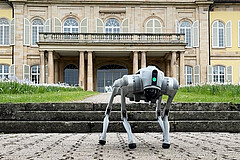
Some degree programs such as “Digital Management” or “Information Systems” already have digital transformation in their name. However, students on all other degree programs at the University of Hohenheim also experience well thought-out digital elements, qualification opportunities, and service offerings which are at the cutting edge.
Digital skills during studies
This is made possible by the “AI & Data Science Certificate Hohenheim” concurrent certificate program (AIDAHO): From basic modules on AI and data science to intelligent agricultural robots, financial data science, or an introduction to Bioinformatics, students have a wide range of options from which to choose.
However, digital and IT skills are also playing an increasingly important role in the regular curriculum. In 2025, the University of Hohenheim awarded the new Digital Teaching Prize for the first time. Among other things, prizewinner Dr. Christian Krupitzer from the Food Informatics department uses a smart “learning factory” made from Fischertechnik that simulates the processes of Industry 4.0 technologies on a small scale.
Using AI competently, securely, and critically in their studies
The University of Hohenheim is also one of the pioneers when it comes to the use of AI in studies. As early as 2023, it was one of the first universities in Germany to adopt a guideline that consistently focuses on teaching AI skills, a critical and responsible approach, and conscious integration into studies instead of bans.
All students at the University of Hohenheim have access to “GPTalk,” a free and data protection-compliant open source platform that can be used in a similar way to ChatGPT, Gemini, etc.
E-assessments, digital services, and virtual learning environments
The digital transformation is also becoming increasingly prominent in more and more areas of everyday student life: In the winter semester 2025/26, for example, students took almost 4,000 e-assessments. Some of these can also be completed using their own laptop (“bring your own device”). The University of Hohenheim offers lecturers a special support structure for this.
Digitalization can make grading and inspection more efficient, especially for large courses. The ExamBuddy project goes one step further and gives students detailed feedback with the help of specially trained AI – in cases where this would otherwise only be possible to a limited extent due to the very high number of participants.
Moreover, anyone who has questions about the library, Wi-Fi on campus, the Hohenheim user account, or the printing and copying services can now not only contact the Service Desk in person, but also the specially trained chatbot of the Communication, Information, and Media Center (KIM) 24/7.
Virtual learning environments are also increasingly being used: Thanks to a campus license for the “Labster” virtual laboratory, students can digitally simulate natural sciences experiments and methods, and prepare for internships and real laboratory work regardless of time and place.
Digital transformation as a linking intradisciplinary research topic
The great importance of digital skills in teaching and the digital services in everyday student life are not least an expression of the University of Hohenheim’s specific research profile.
From AI in agricultural engineering and digital processes in the production of innovative foods to Industry 4.0 and Information Systems, digital transformation has played a central role for many years as a intradisciplinary topic that connects all faculties. As a connecting think tank, the Computational Science Hub networks research and teaching activities across the boundaries of faculties and institutes.
Research-based learning with digital methods
Students who would like to experience current research with digital methods and tools in small groups during their basic study period can slip into the role of scientists themselves as part of the “Humboldt reloaded” program.
There is a choice of research-related project seminars on topics such as automated image analysis to identify leaf-cutter ants, simulating plant growth under climate change conditions using data-based models and digital analysis tools, or investigating technology acceptance in organizations in the context of demographic change.
Additional information
Digital Campus Index 2026: https://uninow.com/de/digital-campus
Text: Leonhardmair
