
How the turtle got its shell: New DFG-funded Emmy Noether Research Group “Turtle Origins” [02.06.26]
PRESS RELEASE
State Museum of Natural History Stuttgart and University of Hohenheim
Led by palaeontologist Dr Stephan Spiekman, a new Emmy Noether Research Group funded by the German Research Foundation (DFG) is launching at the Stuttgart Natural History Museum and the University of Hohenheim.
One of the major unresolved questions in evolutionary biology is how turtles originally came into being and where they fit into the tree of life. A new Emmy Noether Research Group, funded by the German Research Foundation (DFG), is now dedicating itself specifically to this topic. The ‘Turtle Origins’ group, led by Dr Stephan Spiekman, is based at the State Museum of Natural History in Stuttgart (SMNS) and at the University of Hohenheim. Both institutions have been working closely and successfully together for many years.
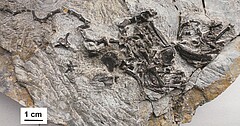
Evolution of turtles and adaptations in body structure
Turtles are unique among terrestrial vertebrates in that their bony shell incorporates ribs, abdominal ribs, vertebrae and parts of the shoulder girdle. Whilst this effectively protects their torso, it also renders it completely immobile. This distinctive feature required fundamental adaptations to the rest of the body, including the respiratory system, the skull, the neck and the limbs. “These changes and adaptations have enabled turtles to survive for more than 200 million years,” says Dr Stephan Spiekman, palaeontologist at the State Museum of Natural History in Stuttgart and at the University of Hohenheim. Until recently, however, it was unclear exactly how this transformation took place, as the relevant fossils showing this transition were unknown. Only new fossil finds in the last 18 years from Germany and China now make it possible to investigate this development in detail for the first time.
A comprehensive research approach
The new project is investigating various aspects of the biology of early turtles to develop a scenario for the evolution of their unique body plan. Modern imaging techniques such as high-resolution computed tomography scans, anatomical analyses and investigations into the evolutionary relationships between early turtles and other reptiles from this period will be conducted. A particular focus is on Pappochelys rosinae from the Middle Triassic near Vellberg in Baden-Württemberg. Although it did not yet have a shell, it already exhibited features that identify it as a link between turtles and other reptiles.
Using high-resolution computed tomography scans, detailed 3D reconstructions of the skull and skeleton of Pappochelys rosinae are now to be produced for the first time, enabling researchers to carry out more precise analyses and comparisons with other reptiles. The fossils of Pappochelys rosinae are held in the collection of the State Museum of Natural History in Stuttgart and are on display in the exhibition.
Fossils of other early turtles, such as the half-shelled Odontochelys from the Late Triassic period in China and the fully-shelled Proganochelys from Germany, are also being studied. Their 3D models will later also be subjected to biomechanical analysis to better understand their way of life. A key question for the researchers is whether Pappochelys still breathed using its ribs like other reptiles, or whether – like modern turtles – it had already lost this ability due to its broad ribs.
Placement of turtles in the tree of life
“Thanks to new research and crucial insights into the earliest turtles, we will be able to reassess their place in the evolutionary tree of life. This remains one of the biggest unresolved questions in the systematics of vertebrates. The earliest representatives of turtles, such as Pappochelys, play a central role in this”, says Dr Spiekman. One aim is to use statistical methods to clarify the relationships with other reptiles from the Permian and Triassic periods. Finally, all the results will be compared with data from developmental biology. This will provide a new overall picture of the origins of the turtle’s body plan and the development of key characteristics, including the reconstruction of the hypothetical last common ancestor. “The research thus provides new insights into one of the most extraordinary cases of evolutionary innovation among terrestrial vertebrates,” adds the palaeontologist.
Funding by the DFG: Emmy Noether Programme
The German Research Foundation (DFG) is funding the Emmy Noether Research Group “Turtle Origins” with around 1.5 million euros. The Emmy Noether Programme is aimed at particularly qualified early-career researchers and enables them to independently lead a research group over a period of six years, thereby qualifying for a professorship. The project leader, Dr Stephan Spiekman, and his team will collaborate with colleagues from the Universities of Tübingen and Erlangen, as well as Humboldt University in Berlin, the Urwelt-Museum Oberfranken in Bayreuth and the Institute of Vertebrate Paleontology and Paleoanthropology (IVPP) in Beijing (China).
BACKGROUND: State Museum Natural History Stuttgart
The State Museum of Natural History Stuttgart is a forward-looking research and communication institute. Its scientific collections – archives of diversity – comprise more than 12 million objects. The museum researches the evolution of life, analyses the biodiversity of various ecosystems and communicates research findings to the general public.
www.naturkundemuseum-bw.de
BACKGROUND: University of Hohenheim
Founded in 1818 in response to devastating famines, the University of Hohenheim is Stuttgart’s oldest university. Even 200 years later, this highly specialised university remains true to its founding mission: to make innovative contributions to solving global challenges through research and teaching. Today, it is Germany’s number one institution for agricultural research and food sciences, and is also a leading and unique centre for the natural, economic, social and communication sciences. The University of Hohenheim conducts teaching and research on topics such as the bioeconomy, sustainability, climate protection, species conservation, food security and alternative energy and raw material sources.
www.uni-hohenheim.de
Links
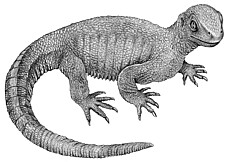
Reconstruction of the ancient turtle Pappochelys rosinae.
Copyright: Rainer Schoch
- Video: Stephan Spiekman talks about the “Turtle Origins” project (Copyright: SMNS, Yannik Scheurer)
- Palaeontological research at the State Museum of Natural History Stuttgart
- Department of Palaeontology at the University of Hohenheim
Dr Stephan Spiekman heads the Emmy Noether Research Group “Turtle Origins”.
Copyright: SMNS, Maximilian Schwarz
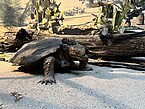
Model of the turtle Proganochelys quenstedtii
Copyright: SMNS, Zoe Pohl
Text: SMNS
Contact for press:
Dr Stephan Spiekman, Department of Palaeontology
State Museum of Natural History, Stuttgart
University of Hohenheim, Department of Palaeontology (190r)
Phone ++49/(0)711/89 36/170
Email: stephan.spiekman@smns-bw.de
For Media:
Meike Rech
State Museum of Natural History Stuttgart
Communications Department
Phone ++49/(0)711/8936/107
Email: meike.rech@smns-bw.de
Florian Klebs
Press Officer, University of Hohenheim
Phone: ++49 /(0)711 459 22001
Mobile: ++49 /(0)170 77 83 182
Email: presse@uni-hohenheim.de


