Expert list Animal Protection / Animal Welfare

How animals are kept continues to get negative headlines. Cheap meat has its price, but in the end it’s the animals who pay. Fewer and fewer consumers find this acceptable. Only by ensuring the animals’ well-being in the stalls can animal husbandry continue to find acceptance in society. At the University of Hohenheim, many scientists are researching projects related to animal well-being. You can find the respective contact persons in the expert list.

Note: Contact persons for piglet castration see Expert list piglet castration

1 Species-appropriate handling


Animal welfare and protection - what can politics do?

What is the state of animal welfare in Germany, Europe and worldwide? Which legal regulations are more conducive, which hinder? Where is there still room for improvement? How can efforts to improve animal welfare be made successful?

Prof. Dr. Christine Wieck is a member of the Scientific Advisory Board for Agricultural Policy, Nutrition and Consumer Health Protection (WBAE) of the German Federal Ministry of Food and Agriculture and deals with German, European and international agricultural and food policy in a globalized world.

Contact: Prof. Dr. Christine Wieck, Department of Agricultural and Food Policy, +49 711 459 22656, E-mail


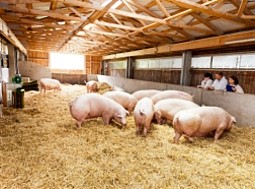
What are characteristics of an animal-friendly stall?

What activities should be available for the animals? How should the floors be designed in order to fulfill the animals’ various needs? What are the possibilities for structuring the space in a way that is animal friendly? You can obtain answers from Prof. Dr. Eva Gallmann from the Department of Livestock Systems Engineering.

Contact: Prof. Dr. Eva Gallmann,  Center for Livestock Technology, +49 711 459 22508, email


Better ventilation technology for a good stall climate

Quelle: Universität Hohenheim / Sacha Dauphin

Ideally, fattening pigs should have access to outside air. But from an environmental protection perspective, the uncontrolled emissions then pose a problem. Prof. Dr. Eva Gallmann wants to resolve this contradiction between animal welfare and the environment. She is assessing how ventilation techniques can ensure a good stall climate with low emissions. Effecting possibilities for cooling are also important to prevent heat stress.

Contact: Prof. Dr. Eva Gallmann, Center for Livestock Technology, +49 711 459 22508, email


Sustainable livestock farming and meat substitutes as a trend

Sustainable husbandry of farm animals - is this an alternative for consumers? How should animal products be labeled so that consumers can make informed choices? Under what conditions would they be willing to reduce their meat consumption, and are meat substitutes a real alternative for people? Jun.-Prof. Dr. Ramona Weinrich researches the conditions for this.

Contact: Jun.-Prof. Dr. Ramona Weinrich, Department of Consumer Behavior in the Bioeconomy, +49 (0)711 459 22876, email

2 Animal health

Relaxed sows - healthy piglets

Image: University of Hohenheim | Oskar Eyb

The way sows are kept affects the animals’ well-being. Do the animals have a better life in social groups? How much does social instability stress the animals when the group is mixed? What factors influence the animals’ behavior? What consequences result for their young from how the animals are kept? How does it affect their immune status and health?

Discuss these questions with Prof. Dr. Volker Stefanski from the Department of Behavioral Physiology of Farm Animals.

Contact: Prof. Dr. Volker Stefanski, Department of Behavioral Physiology of Livestock, +49 711 459-22455, email

What conditions promote animal health?

The health of the livestock is key for their well-being. To what extent does the way the animals are kept affect their health? For over 40 years, the Department of Environmental and Animal Hygiene has analyzed how the hygiene and environment can be optimized for this purpose. The research focuses are in the area of environmental hygiene and animal health.

Contact: Prof. Dr. Ludwig E. Hölzle, Department of Environmental and Animal Hygiene, +49 711 459 22427, E-mail

Electronic animal marking for the purpose of animal health

Electronic marking of the individual animals also serves to monitor their health. It makes it easier for the operations to carry out self-controls according the Animal Welfare Act and for monitoring antibiotics. Links between illnesses, treatments, or vaccinations can thus be better recognized. With the use of monitoring systems, illnesses and therefore also the use of medications is to be minimized. Prof. Dr. Eva Gallmann explains how this works. She develops and tests various methods of animal identification.

Contact:
Prof. Dr. Eva Gallmann, Center for Livestock Technology, +49 711 459-22508, email

Physiological background of animal health

Quelle: Universität Hohenheim | Oskar Eyb

How does an organism work in general? For example, how exactly does the digestion of cattle, pigs, or horses work? What particularities are there in chickens? What external influences can harm the animals, do the animals have respective sensors? For questions on the anatomical-physiological background of animal health, contact the veterinarians Jun.-Prof. Dr. Franziska Dengler and Prof. Dr. Korinna Huber.

Contact:
Prof. Dr. Korinna Huber,
Department of Anatomy and Physiology of Livestock, +49 711 459 22410, email
Jun.-Prof. Dr. Franziska Dengler, Department of Functional Anatomy of Farm Animals, +49 711 459 23307, email

Press releases