
Honey bees:
Wild populations in the EU on the Red List for the first time [17.09.26]
Study by the University of Hohenheim and Agroscope (Switzerland) shows a significant decline in the wild populations | ICUN: Wild honey bees “endangered” in the EU
Populations of the Western honey bee (Apis mellifera) are under massive pressure in the wild in Europe. New scientific research by researchers at the University of Hohenheim in Stuttgart and Agroscope in Zürich has admittedly shown that there are frequent occurrences of honey bees in the wild in Europe. However, the researchers estimate that the populations of these bee populations in the European Union (EU) will fall by around 56 percent within ten years without the influx of swarms from beekeepers. Therefore, wild honey bees are now officially classified as “endangered” across the EU on the International Union for Conservation of Nature’s (IUCN) Red List.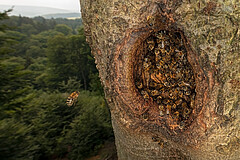
Many people see honey bees as solely commercial animals in beekeeping, pollinating flowers and producing honey. In fact, however, there are numerous wild populations which nest, for example, in natural tree hollows, rock crevices, and hollow walls, and sustain themselves independently of humans. They account for around one sixth of the entire European population of honey bees. However, not much has been known to date about these wild honey bees and their ecological, economic, and evolutionary importance.
“This means that, based on current data, a clear biological separation between honey bees in the wild and managed honey bees is not sustainable,” according to Dr. Patrick Kohl from the Livestock Population Genomics department at the University of Hohenheim. “Wild populations of bees have been a source for beekeeping for millennia. The two groups still intermingle today, for example when young queen bees from beekeeping operations mate with drones from wild bee colonies during their nuptial flights. Or when an entire swarm of bees leaves the hive, settles in an old woodpecker hollow in the forest, and thus becomes part of the wild subpopulation once again.”
Key role for genetic variety
However, why are wild honey bees interesting if this species is the same as that maintained by beekeepers? “Wild honey bees enjoy a tremendous genetic diversity,” Kohl said. “For example, we can find populations of bees in the wild in America, able to handle the notorious Varroa mite. This blood-sucking parasite, which originates from Asia, is able to wipe out entire populations of bees. The lack of chemical treatment against the mite in the wild population has led to the natural selection of colonies resistant to these parasites.”
“In their natural European breeding ground, the remaining wild populations of honey bees are reservoirs for subspecies which have become rare. In this vein, some wild populations in Great Britain are largely congruous with the European honey bee Apis mellifera, which has long been neglected in beekeeping.” In his view, beekeeping in this country, too, could benefit from the genetic adaptability of a wild honey bee population to diseases or environmental conditions.
Large regional differences in Europe
However, the honey bee is under increasing threat as a wild animal in Europe. Whereas international research cooperations have documented more than 1,600 nesting places in 15 countries, there continues to be a lack of comprehensive data on their distribution, size of populations, and development.
For their estimates of the population trend, the researchers analyzed the survival data of wild bee populations, which was collected by way of targeted monitoring of known nesting places in several European countries. Models were harnessed to calculate how the colonies of bees in the wild would progress without migration from beekeeping operations.
The result is clear: The populations would shrink on average by around 56 percent within a decade. “Around the world, Europe has the lowest density of honey bee colonies in the wild,” according to Dr. Benjamin Rutschmann from Agroscope in Zürich, the Competency Center of the Swiss Confederation for Agricultural Research.
He added that stark regional differences are noticeable: Whereas some populations in central Europe are under significant threat, there are stable colonies in England, for example. “When taken in the round, however, many populations in the wild will not be able to survive from their own endeavors and are reliant on an influx from beekeeping operations,” Rutschmann said.
Honey bees in the wild classed as “endangered” in the EU for the first time
Based on studies by the research team, honey bees in the wild have now been categorized by the International Union for Conservation of Nature (IUCN) as “endangered” and placed on the International Red List of threatened species.
“Although it is the same species as held as commercial animals in beekeeping, wild honey bees are to be viewed as standalone wild populations according to the IUCN criteria,” Kohl explained. The criteria state that, in the context of species with managed and free-living individuals, a population is to be viewed as “wild” if it would not become extinct within a period of ten years without intervention by humans.
Whereas the situation within the European Union is viewed as critical, there is a dearth of sufficient data on the overall European level. Therefore, the species’ status is currently listed as “insufficient data.” However, experts work on the assumption that in many regions of Europe, wild colonies of honey bees have become more rare or have locally already become extinct.
Causes: loss of habitat, human influences, and parasites
There are multiple reasons for the decline and form the subject of current research. A main factor is the ongoing loss of suitable habitats by way of intensive land use and development. Additionally, the disappearance of old trees with natural hollows markedly reduces the available nesting options.
At the same time, the reduction in landscapes akin to nature leads to a lack of nutritional resources such as pollen and nectar, which particularly makes it more difficult for the colonies to survive in the winter. Bee colonies in beekeeping operations are at least partially shielded from these problems. They are able to take advantage of practically ideal artificial hollows (beehives) and they are fed if there is an acute lack of food.
In addition, pathogens and invasive species such as the Varroa mite are a burden on the bee colonies’ health. Chemical burdens from pesticides can also have a negative effect on the populations’ ability to survive. Moreover, modern beekeeping practices, such as those arising from global trade and breeding, may weaken the ability of the wild populations to adjust genetically.
Urgent appeal for more protection measures
The researchers stress that the reduction in wild honey bees is not only a problem for retaining the genetic diversity within the species. “Wild honey bees supplement managed bee colonies geographically. In their natural habitat, open forests and forest edges, we observe numerous interactions with other species,” said Kohl. For example, he is thinking of the pollination of forest plants and of species such as the honey bee louse and various small butterflies which depend on honey bee nests.
Therefore, the researchers are calling for wild honey bees to be expressly recognized as a protection-worthy part of biodiversity and monitor such systematically. At the same time, targeted protection measures are necessary. According to Rutschmann, stable populations of honey bees in the wild are a strong sign for quality of a habitat. “These colonies need old trees with suitable hollows, a versatile range of nutrition and structures akin to nature. Therefore, protecting them not only helps the honey bees themselves, but also many other species relying on structural-rich and flower-rich habitats.”
BACKGROUND: IUCN Red List
The International Union for Conservation of Nature (IUCN) has been compiling Red Lists of endangered species of animals and plants around the world since 1963. To this end, the species are categorized into various categories of risk according to determined criteria. The IUCN Red Lists are based on the estimate of a taxon’s probability of dying out (mostly of a species) within a determined period, mostly taking into account only the natural breeding ground.
What is more, states or German Länder also publish their own Red Lists. Thanks to their regional focus, they are able to go into peculiarities and promote biodiversity in the locality.
Further information about the scientific study
Publication: doi.org/10.1111/csp2.70345
Text: Stuhlemmer
Kontakt für Medien:
Dr. Patrick Kohl, University of Hohenheim, Department of Livestock Population Genomics,
+49 711 459 22484, patrick.kohl@uni-hohenheim.de
Dr. Benjamin Rutschmann, Agroscope Zürich,
benjamin.rutschmann@agroscope.admin.ch
